
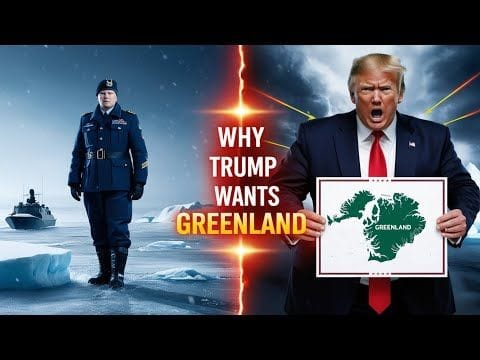
In a remarkable development that has captured global attention, France has explicitly warned President Donald Trump that any attempt to occupy Greenland would be considered an attack on Europe. This unprecedented situation has sparked intense international discourse and raises serious concerns about the future of NATO alliances. Let’s dive into the details.
Table of Contents
Trump’s Controversial Statement
As reported worldwide, Donald Trump recently made a startling declaration about Greenland, stating that “the USA can also use its military to occupy Greenland.” This aggressive stance toward “the world’s largest TAPU” has created significant diplomatic tension, particularly because Greenland is officially part of the Kingdom of Denmark.
Trump’s position can be summarized in his own terms: “either sell it, or we will buy it, or if there is no agreement on the deal, then we will conquer it.” This language, as many observers note, bears striking similarities to Russia’s approach in Ukraine.
France and Germany’s warnings
French leaders declared that any military action on Greenland would be considered an attack on Europe, while German Chancellor Olaf Scholz emphasized the need to respect national borders. This escalating rhetoric has revealed cracks in NATO’s unity, with its members directly opposing one another.
Why Greenland? The Strategic Importance
Greenland is no ordinary territory; it holds immense strategic value:
- Natural Resources: Greenland is rich in lithium, crude oil, and geothermal energy.
- Trade Routes: With climate change melting Arctic ice, the Northwest Passage is opening up, offering a shorter route for global shipping between the U.S. and Europe.
- Military Advantage: As a gateway to the Arctic, control over Greenland would grant significant military leverage.
Table: Comparing Trade Routes
| Route | Current Distance | Potential Distance via Northwest Passage |
|---|---|---|
| San Francisco to Europe (via Panama Canal) | Long | Shortened significantly |
| Arctic Route through Greenland | N/A | Emerging as a direct alternative |
The Putin Connection
The situation has drawn interesting parallels to Russian foreign policy. As the source notes, “when it became official that Donald Trump will become the next president of the USA, if a man was most happy to hear this news, then it was Vladimir Putin.” The reasoning behind this observation is clear: under Trump’s leadership, “the USA will become a very aggressive country… a country that will appear much more aggressive in the world than Russia, even China.”
The NATO Crisis
The situation presents a peculiar and unprecedented challenge for NATO:
- Greenland is a NATO member
- The United States is a NATO member
- Trump threatens military action against another NATO territory
As the source directly states, “Trump said a sentence in one line, destroyed the unity of NATO, Europe and the United States.” The gravity of the situation is underscored by German Chancellor Olaf Scholz’s personal involvement, who “himself warned Donald Trump that do not occupy Greenland, you will have to respect the borders of the country.”
France and Germany’s Stance
The strong opposition from NATO allies highlights their disapproval of Trump’s aggressive rhetoric and strategy. Both nations argue that such moves undermine global cooperation and threaten the unity of the NATO alliance. Germany has urged for a diplomatic approach to resolve disputes over Greenland, avoiding unnecessary conflicts.


The Climate Change Factor
The source provides crucial context about climate change’s role in this crisis:
- Trump “knows that nothing will be done to fight global warming and climate change in his time”
- Instead, “Trump will extract more coal and more oil”
- Global temperature increases are causing polar ice to melt continuously
- This creates what some see as “an opportunity to earn more money”
The Strategic Northwest Passage
A key element in this crisis is the Northwest Passage. As the source explains in detail: “if you want to take a ship from San Francisco to the UK or any other country in Europe, then you will go from San Francisco to the south, then what will you cross? Panama Canal, after crossing the Panama Canal, you will cross the entire Atlantic Ocean and reach Europe.”
The Northwest Passage would provide a crucial alternative: “go straight from San Francisco to the south, from Canada to Greenland and reach Europe easily.” This would result in:
- Saved time
- Reduced effort
- Lower fuel consumption
- New trade route opportunities
The Economic Perspective
The source reveals significant economic details about Greenland:
- Estimated value: 1.5 trillion US dollars
- Rich in lithium reserves
- Significant crude oil deposits
- Substantial geothermal energy potential
Frequently Asked Questions (FAQ)
Q: Why is Trump specifically interested in Greenland?
A: The interest stems from multiple factors: the Northwest Passage potential, natural resources including lithium and crude oil, and strategic military positioning.
Q: What makes the Northwest Passage so important?
A: As explained in the source, it offers a shorter, more efficient route from the US West Coast to Europe, bypassing the Panama Canal.
Q: How does climate change factor into this situation?
A: The source explains that melting polar ice is making new shipping lanes possible and accessing resources easier, though this comes with severe environmental consequences.
Q: What is the estimated value of Greenland?
A: According to the source, economists estimate Greenland’s value at approximately 1.5 trillion US dollars.
3. How does Greenland’s autonomy affect this situation?
Greenland is a part of Denmark but has self-governing status, making it integral to European geopolitics and NATO’s framework.
4. Has the U.S. attempted to buy Greenland before?
Yes, the U.S. has expressed interest in Greenland multiple times due to its strategic location and resources.
5. What impact could this have on NATO’s unity?
Conflicts over Greenland could strain relationships within NATO, as its members have opposing views on this matter.
The Broader Implications
The source suggests several possible motivations behind Trump’s approach:
- Diverting attention from domestic issues
- Using aggressive foreign policy to rally domestic support
- Attempting to prevent Russian control of the Northwest Passage
- Seeking economic advantages through military means rather than negotiation
Looking Forward
The situation remains fluid, with serious implications for:
- NATO unity
- International law
- Climate change policy
- Global trade routes
- Diplomatic relations between the US and Europe


Stay updated with Capsule Post for the latest news and insights of Nifty Crashes, HMP virus, Ketan Parekh 65Cr front-running stock market scam, and the recent development in Canada Justin Trudeau resigns
OnePlus 13 Unboxing: A Glimpse at the Almost Flagship